

Short answer: Calculating the right depth for your farm dam is a critical step that balances maximising storage volume against minimising evaporation, construction cost, and safety risks. Deeper dams generally lose less water to evaporation relative to their volume, but construction costs and structural requirements increase with depth. Finding the sweet spot requires careful analysis of your catchment, water needs, and site conditions.
Quick Answer: The ideal farm dam depth balances volume, evaporation loss, soil conditions, and construction cost. For most NSW and QLD farm dams, 3–5 metres of working depth is the practical target. Shallower dams lose more to evaporation proportionally; deeper dams cost more and require more careful engineering. Your soil profile and the available height of cut on site set the practical limits.
A key secret to define the optimal dam depth
Know your DSV ratio.
The depth to surface to volume ratio (DSV) is probably the most important aspect of successful dam design and that’s the parameter that answers the question how deep your dam should be .
If you get it wrong, the terrible effects are not immediately obvious.
But they will make you cry
So you better know how deep your dam should be in order to avoid them.
Let’s take the dam depth above as an example, because this dam is badly designed with regard to its DSV ratio
A bathymetric analysis of the current shape and depth shows that this dam is capable of losing $59,000 worth of water every year (bathymetry is the study of water depth)
To answer the question of how deep your dam should be, it’s necessary to conduct the calcualtions before the construction, otherwise, the consequences will be similar to the ones we can see on the example of this dam .
The current dam depth vs surface area vs volume ratio of .33 is causing the aquatic inversion layer (also known as the thermocline) to be in an abnormally low position relative to the water surface and the dam base – and is therefore causing excessive & significant water warming and loss through evapo transpiration
The lack of the dam depth is also causing the inversion layer to have an abnormally low thermal lapse rate – eg the lower depth is not as cold as it should be (the thermal lapse rate is the rate at which the temperature of water changes with depth – normally 3 degrees Celsius per metre on an exponential scale)
In basic terms – water becomes colder with depth, but warmer as it approaches the surface.
Evaporation happens when water molecules are heated to a higher temperature than their surrounding environment.
At this point, they start to detach from the water body and rise into the atmosphere and are lost – returning to earth eventually as rain.
That’s why it’s so important to know how deep your dam should be and properly calculate the dam depth beforehand to avoid these consequences.
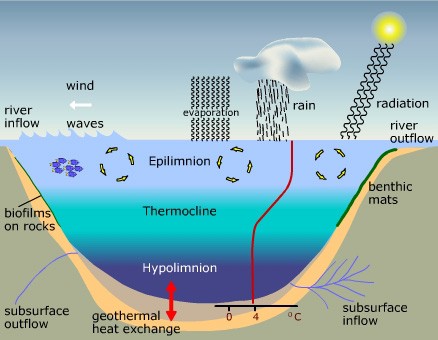
As the sun shines – it heats the water to a certain depth – usually 1.5 metres. This is where the aquatic inversion layer exists in most water bodies.
All water between this level and the surface is subject to warming and therefore loss through evaporation. Most water below 1.5m depth is not.
Warm water (known as epilimnion), which is less dense, will sit on top of colder, denser, deeper water (known as hypolimnion) with a blanket-like impervious thermocline layer separating them.
Very little mixing of the warm water and the cold water occurs because of this aquatic stratification.
When you swim in a lake, you can feel the cold hypolimnion below the aquatic inversion layer – normally this occurs around your toes.
When you swim in the shallow end of a swimming pool, you don’t feel the aquatic inversion layer.
In shallow pools, this means that 100% of the water is heated up and would be lost to evaporation over a short period of time.
In lakes, the first 1.5 metres of water is warmed up, but many many metres beneath are not.
If the lake was 150 metres deep, only 1% of it’s total volume would ever be lost to evaporation.
This is why lakes do not dry up.
Inversion layers are a permanent and important feature of water with depth.
The dam being discussed is currently like a big teacup saucer, with 50% of the water contained in it when full being subject to evaporation.
This is best visually represented by the graphic on the left.

So how deep your dam should be?
With a total depth of 3m and the inversion layer at 1.5m, this means the inversion layer is sitting in the middle of the depth axis, thereby exposing 50% of total volume to evaporation.
The dams current DSV value is .33
If the dam depth was 6m, its DSV value would be .16, and this would mean that evaporation losses would be reduced by 50%.
This would mean a saving of 59 megalitres of water per year.
Compare the dams below. Both contain the same volume of water.

The depth of water removed by evaporation will be much the same in both dams, but the total volume of water lost from the shallow dam will be significantly more.
The dam that is deeper and has steeper sides will retain water for longer – because the water will be cooler in this dam, thereby helping to reduce evaporation.
Evaporation is hard to measure precisely due to the number of factors that effect it – such as:
• air temperature
• water temperature
• latitude
• longitude
• tidal action
• surface area
• depth
• wind velocity
• turbidity
• currents
• temperature range
• humidity
However, a basic calculation for the dam depth will show that a water body with 100% of its total volume effected by high direct heat exposure will lose up to 2% of its total volume every day to evaporation.
This all means that this dam in its current configuration could lose its total volume every 50 days – or 7.3 times per year if it were to fill every time it emptied.
Given the dams total capacity of 16.1mgl – a total of 118.04 megalitres is capable of being lost purely to evaporation from this one dam.
In monetary terms, if one were to price water at $500 per megalitre – this would represent a financial loss of $59,000 each and every year for this dam due to the improper calculation of dam depth.
Key Takeaways
- Depth and surface area together determine volume — maximise depth to reduce evaporation as a percentage of storage
- 3–5 metres working depth is a practical sweet spot for most NSW and QLD farm dams
- Deeper dams require more engineering — freeboard, batter slopes, and spillway design all change with increased depth
- Poor soil at depth (gravel, rock, dispersive clays) can make a deeper dam expensive or impractical
- Get a soil profile done before finalising depth — it changes the economics and feasibility dramatically
Frequently Asked Questions
What is the minimum depth a farm dam should be?
2 metres of working depth is a practical minimum. Shallower than that and evaporation losses become unacceptably high in hot Australian summers, and the dam may completely dry out in drought years.
Is there a maximum depth for a farm dam?
No hard maximum, but deeper dams require more engineering and in some states trigger extra regulatory requirements. For most farm dams, 5–8 metres is the upper practical range.
How do I calculate the volume of my dam?
Volume (ML) ≈ average surface area × depth × 0.4 for a typical bowl-shaped dam. For a more accurate figure, survey the site contours and use a proper volume calculation from your designer.
Does a deeper dam cost more to build?
Yes, but not always proportionally. Deeper cuts move more earth, but the volume-to-surface-area ratio improves, meaning more water storage per dollar spent long-term.
For a deeper look at this question, see our guide on How Deep Should a Farm Dam Be?.
Need help with your own dam? Book a site inspection with Big Ditch — we build and repair dams across NSW, Queensland, and Victoria.
Practical dam advice, straight to your inbox
Get an email when Big Ditch publishes a new article about dam construction, repairs or water management.
Get dam updates
Confirm your email to subscribe. Unsubscribe at any time. Privacy Policy